
01 / UPWARD MOBILITY / FINTECH UX
A faster path
to a second chance.
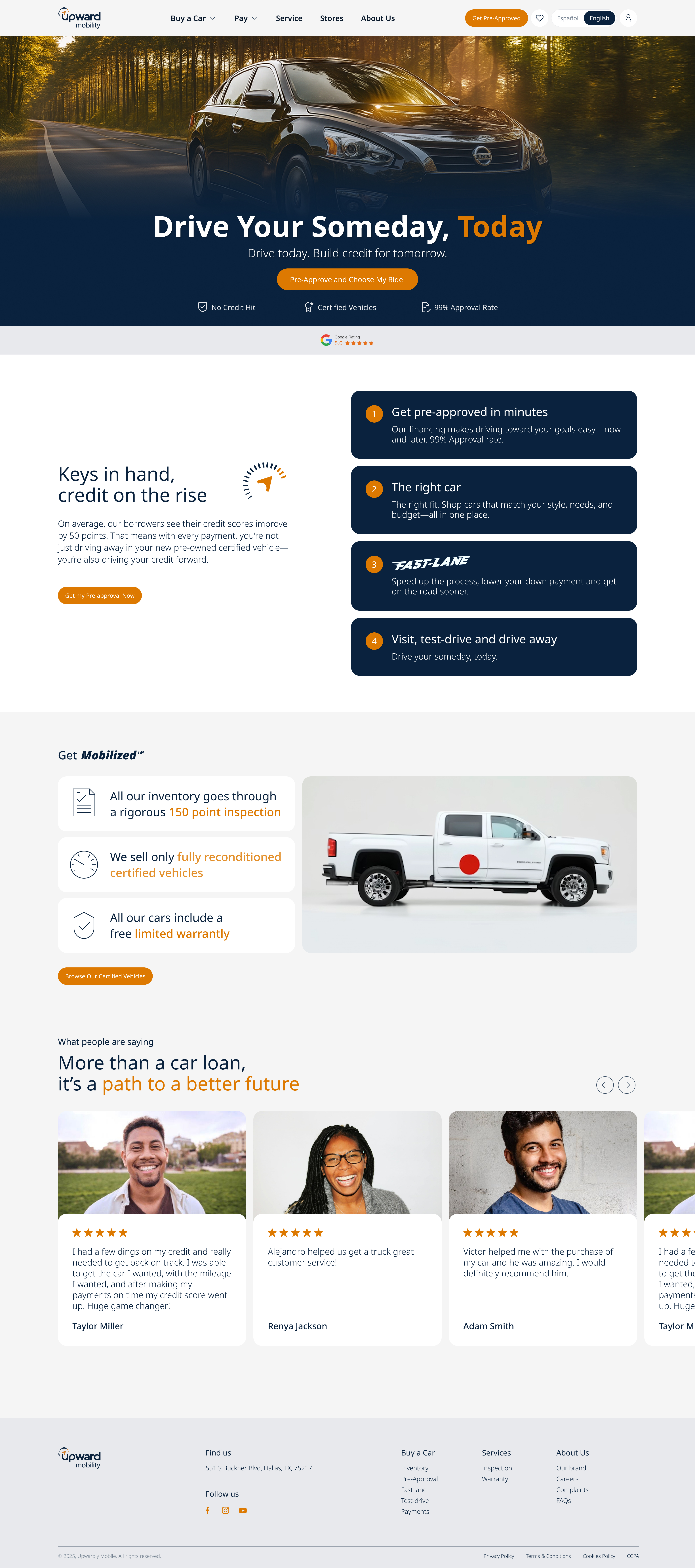
Upward Mobility is a responsive auto-financing experience created for customers who had often been rejected elsewhere because of challenged credit histories.
The experience was designed around a faster, lower-friction application path—giving customers a clearer way forward and an opportunity to rebuild their credit.

02 / THE CHALLENGE
They weren’t new to applying.
They were tired of applying.
Many customers arrived after being rejected by other lenders—often more than once. They knew lengthy applications, repeated questions and the frustration of not knowing whether another process would lead anywhere.
The challenge was to respect that fatigue: reduce unnecessary steps, establish trust quickly and offer a faster path forward despite their credit history.
Application fatigue
Repeated applications and rejection left little patience for another lengthy process.
Trust barrier
Show early that Upward evaluated their situation differently and offered another opportunity.
Time to value
Every unnecessary step risked losing someone already tired of the process.
03 / UNDERSTANDING THE CUSTOMER
Different credit histories.
Shared uncertainty.
Understanding the customer meant considering both their credit history and their previous experience of applying. Another form could feel like another demand on their time.
Starting a credit history.
Little or no established credit history.
- Accessible guidance and clear expectations
- Transparent requirements, with less effort
- Confidence that their history keeps the conversation open
Finding a way forward.
Recovering from previous credit challenges.
- Respect for their time and previous experience
- Reduced uncertainty and respectful communication
- A clear next step toward another opportunity
Respect their time.
Make the next opportunity clear.
04 / DESIGNING THE PATH
From repeated friction
to a more direct path.
Customers were arriving with the fatigue of previous applications and rejections. The experience needed to respect that context by reducing unnecessary effort, prioritizing what was essential, and creating a more direct path through the financing process.
AI-assisted exploration helped us evaluate alternative flows and identify opportunities to simplify the journey before moving into detailed interface design.
- 01
Enter
Start with less friction
→ - 02
Qualify
Identify the right path
→ - 03
Apply
Focus on essential information
→ - 04
Complete
Reduce repeated effort
→ - 05
Move forward
Reach an outcome sooner
↗
Less repetition · Essential information · Faster progression
THE PRODUCT DECISION / FAST LANE
Designing around
the customer’s time.
Challenged credit should not mean more friction. Fast Lane created a streamlined financing path for people already tired of lengthy applications.
Clear document requirements and a direct next action reduced unnecessary time and effort—communicating another opportunity to move forward and rebuild credit.

05 / EXPLORING THE EXPERIENCE
Reducing friction
before adding polish.
Early exploration made a sensitive financial journey feel straightforward without hiding important information. Rapid wireframing and AI-assisted exploration helped evaluate hierarchy, form structure, progressive disclosure and CTA placement before refinement in Figma.
A clearer path
to your next car.
Understand your financing options and what you need to get started.
Clear requirements✓
Certified vehicles
Know what comes next.
Start with your vehicle needs.
See the requirements before you upload.
Follow a clear next action.
Explain first.
Ask with context.
Respond clearly.
Establish the value before the commitment. Pair document requirements with the upload action. Keep progress and recovery visible.
- Financial complexity
- Structured exploration
- Design judgment
- Refinement
Know what to share.
See what’s happening.
Prepare your documents to continue.
Proof of address
Upload a recent utility bill, lease or driver’s license.
Official ID
Upload a valid government-issued photo ID.
Please try another file.
06 / BUILDING A SYSTEM FOR TRUST
A shared language
for design and engineering.
A reusable Design System kept interaction patterns, states and visual decisions consistent across the financing experience.
Shared structure made components easier to understand, implement and extend—supporting collaboration and AI-assisted development.
Purposeful.
Consistent.
Rounded actions.
Clear direction.
Prepare your documents.
Clear requirements, visible progress.
3MB · Uploading…
Ready for the next step.
Review your information before continuing.
ConfirmationPredictable interactions
Common actions, forms and states behave consistently.
Reusable structure
Shared components reduce variation and support extension.
Clear implementation rules
Predictable naming gives design, engineering and AI-assisted tools a shared context.
PREDICTABLE STRUCTURE / CLEAR IMPLEMENTATION CONTEXT
- FOUNDATIONPrimary orange
- SEMANTIC ROLEMain action
- COMPONENTPrimary button
- IMPLEMENTATIONConsistent action
The designer defines the system. AI works within its structure.
07 / DESIGNING FOR CONFIDENCE
Clarity
at every step.
One responsive web experience.
Clear expectations.
A faster way forward.
Explain the opportunity and the path before asking for commitment.
The same priorities, adapted to a smaller screen.
Relevant vehicle and financial information in one place.
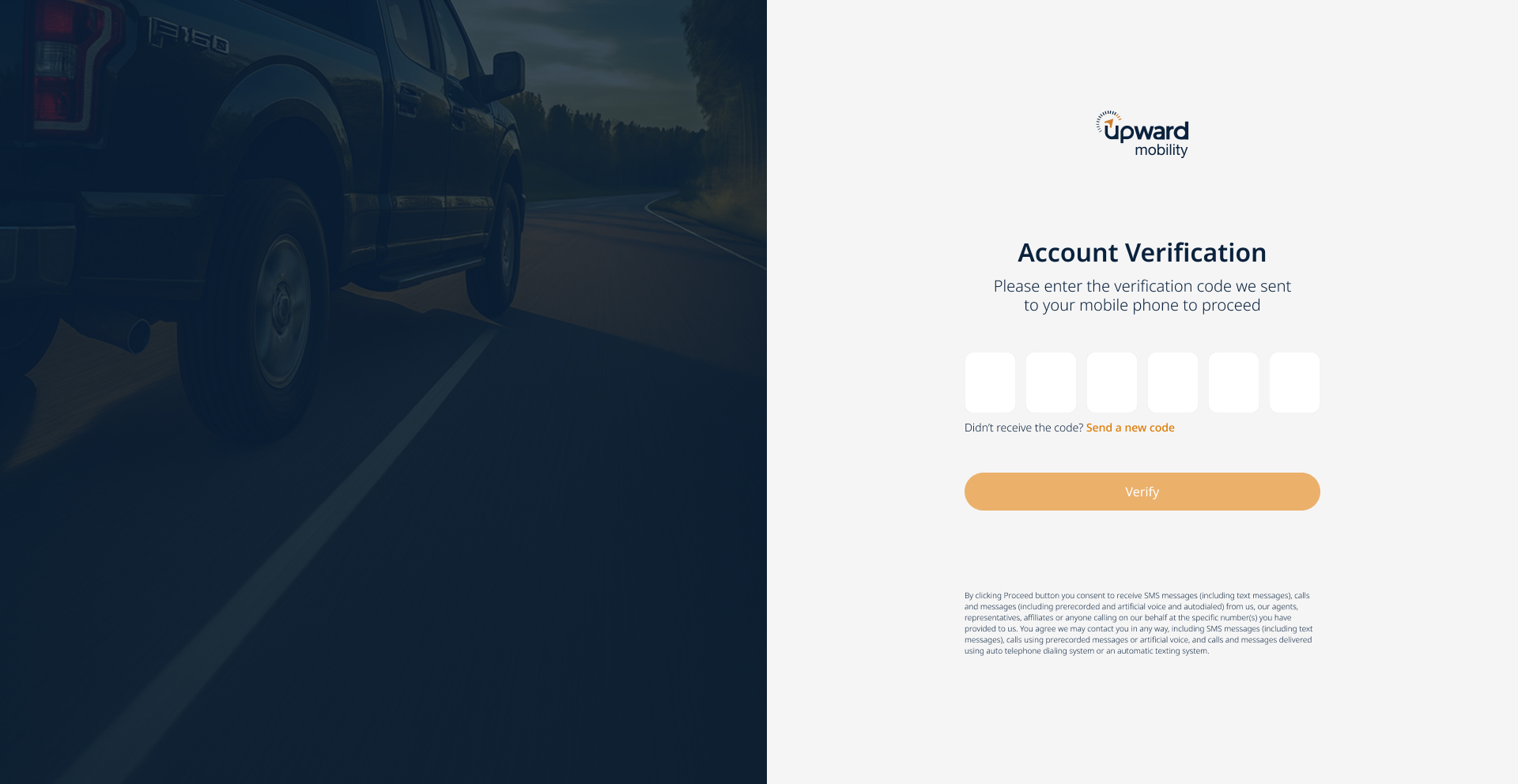
Explain what is needed and how to continue.
08 / REDUCING UNCERTAINTY
The right information
at the right moment.
Establish value early, make choices understandable and guide only the information needed to continue. The hierarchy respects customers’ time across desktop and mobile.
Explain the opportunity before asking customers to begin again.
One focused task, with recovery guidance close at hand.
09 / FROM SYSTEM TO IMPLEMENTATION
Structured design makes implementation easier to scale.
A reusable interface system gave design and engineering a common structure for translating product decisions into implementation.
AI-assisted development with Cursor accelerated parts of that translation while product behavior, usability and visual quality stayed under human review.
- 01→
Product intent
Define the experience
- 02→
Figma
Express the design
- 03→
Structured Design System
Establish the rules
- 04→
Cursor
AI-assisted development
- 05→
Engineering review
Validate with design
- 06↗
Product
Deliver the experience
10 / IMPACT
A faster, clearer path forward.
Less unnecessary friction
A streamlined financing path designed to respect customers’ time.
Clearer expectations
Requirements and next actions make the path easier to understand.
Another opportunity
A way for customers with challenged credit histories to move forward and rebuild credit.
Consistent across screens
A reusable system supports one coherent desktop and mobile web experience.
Shared design / engineering language
Structured components create clearer implementation expectations.
11 / REFLECTION
Financial products become approachable when people understand what happens next.
Financial complexity cannot always be removed, but unnecessary effort can. Designing this experience meant respecting customers’ previous applications and rejection—not asking them to start from a place of unlimited patience.
Upward Mobility reinforced how respect for people’s time, clear expectations, reusable systems and close design–engineering collaboration can make a second opportunity feel more approachable.