
01 / TRICONET / MOBILE PRODUCT DESIGN
Turning a fragmented vehicle operation into one connected workflow.
Triconet is an internal mobile product designed to give teams a clearer view of vehicle operations, performance and day-to-day activity across the organization.
I worked on transforming complex operational information into a mobile experience that made status, performance and relevant actions easier to understand.
02 / THE PROBLEM
Too much information.
Not enough visibility.
The organization managed large amounts of operational information across vehicles, activity and performance. The difficulty was turning that information into a clear operational picture.
Users needed to identify what mattered quickly and move between high-level performance and individual vehicle context without unnecessary complexity.
03 / UNDERSTANDING THE OPERATION
Different roles.
Different questions.
One operational picture.
Research focused on how different users consumed operational information and what each role needed to see first.
Not everyone needed the same level of information. Different roles required different entry points into the same system.
How are we performing?
Performance, trends and overall operational health.
What needs attention?
Vehicle status, activity and immediate priorities.
What do I need to do?
Relevant information and actions, with less navigation.
04 / MAPPING COMPLEXITY
Mapping the operation before designing the interface.
Before defining individual screens, the operational model needed to become understandable. Vehicle information, user needs, decisions and actions were organized to support both high-level visibility and deeper detail.
- 01↓
Operational information
Vehicles · Activity · Performance
- 02↓
Roles & needs
What each person needs first
- 03↓
Information architecture
Group information around context
- 04↓
User flows
Connect decisions and actions
- 05↗
Product experience
A clear mobile hierarchy
05 / EXPLORING THE EXPERIENCE
Finding clarity
before adding polish.
Early concepts balanced operational depth with mobile simplicity. Rapid prototyping and AI-assisted tools such as Lovable helped explore hierarchy, navigation and data presentation before refining the experience in Figma.
Information first.
Decisions next.
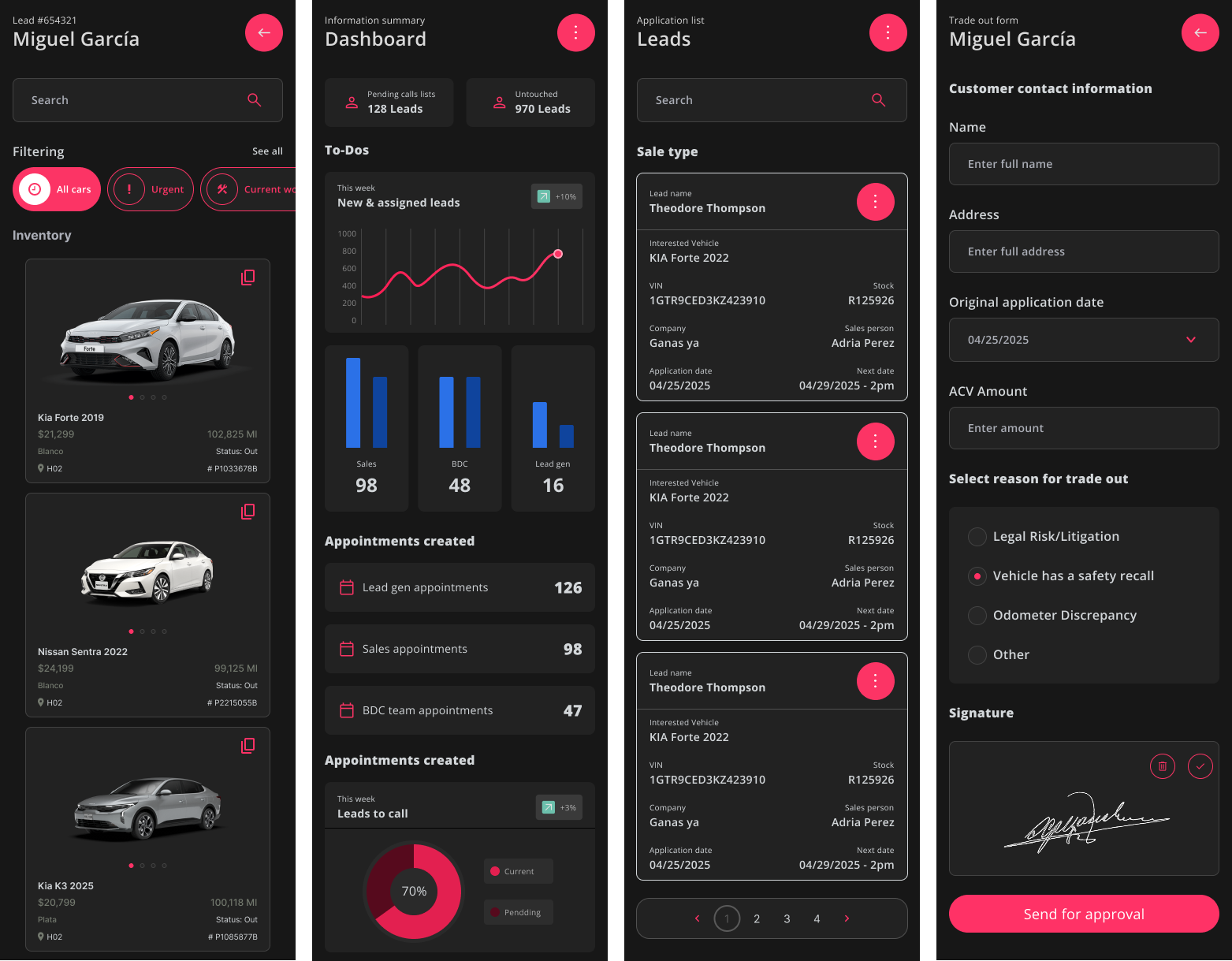
Search and filters establish scope. Grouped information keeps vehicle context visible. Metrics lead into operational detail.
Inventory
Kia Forte 2019
↗Nissan Sentra 2022
↗Kia K3 2025
↗Dashboard
New & assigned leads
Appointments created
AI accelerates exploration. Design judgment defines the product.
06 / BUILDING CONSISTENCY
Complex workflows need predictable patterns.
A dedicated UI Design System established shared interaction patterns. Reusable components, consistent states and a defined visual language made complex workflows more predictable and easier to navigate.
Confirm this action
Review the information before continuing.
Reusable components
Common controls reduce unnecessary variation.
Consistent states
Actions, selections and feedback speak the same language.
Shared visual language
Color and hierarchy connect different areas of the product.
07 / FROM INFORMATION TO DIRECTION
From information
to direction.
Operational depth.
A clearer mobile experience.
Operational overview
Current vehicle information and activity.
Performance visibility
Data and trends that clarify what is happening.
Vehicle context
Relevant detail where decisions are made.
08 / DESIGNING ACROSS LEVELS
From the big picture
to the next action.
Users should be able to move from the broader operational picture to the specific information they need without losing context.
09 / IMPACT
One clearer operational view.
Centralized visibility
Operational information is easier to understand in one connected experience.
Clearer status
Vehicle and operational context is easier to identify.
Faster access to information
A clear hierarchy reduces the effort of finding what matters.
More consistent workflows
A shared structure makes operational tasks more predictable.
10 / REFLECTION
Complexity doesn’t need to disappear.
It needs to become understandable.
Complex operational products rarely become simple by removing information. The design challenge is deciding what matters, when it matters and how users move between different levels of context.
Triconet reinforced the importance of structuring complexity before styling it—using research, information architecture, rapid exploration and iteration to turn operational depth into a product people can navigate with confidence.